
Soil Investigation Services in Thailand
Field investigation for subsurface profiling, soil sampling, Standard Penetration Testing, groundwater observations and laboratory coordination.
What a soil investigation should provide
A soil investigation is intended to establish practical information about the ground conditions beneath a project site. The scope normally combines borehole drilling, sample recovery, field observations, in-situ testing and selected laboratory tests. The resulting information is organized in boring logs and test summaries for use by the project’s engineers, consultants and contractors.
The appropriate number of boreholes, investigation depth and laboratory program depend on the project layout, structural requirements, site access and the technical brief. We therefore prepare quotations around the actual project information rather than applying one fixed package to every site.
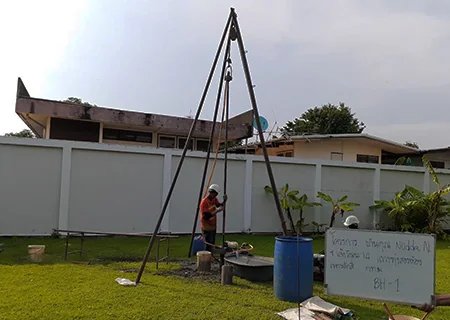
Field investigation components
Borehole Drilling
Drilling advances the investigation to the required depth while allowing field records, sampling and in-situ tests to be carried out at selected intervals.
Wash Boring
Wash boring is commonly used in soil investigation where the intended program includes disturbed sampling and SPT at specified depths.
Standard Penetration Test
SPT provides a field penetration resistance value and is normally recorded together with the soil description, sample depth and borehole profile.
Soil Sampling
Samples are identified by borehole and depth so laboratory results can be correlated with the subsurface profile.
Groundwater Observation
Observed groundwater conditions are recorded when required and when the field conditions permit a meaningful observation.
Boring Logs & Reporting
Field descriptions, sample intervals, SPT records and laboratory results are compiled into an organized project report.
How an investigation is organized
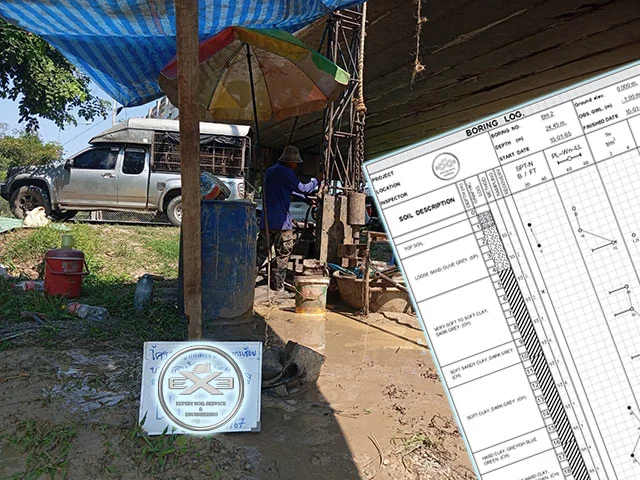
Boring logs connect the fieldwork to the engineering record
A boring log is not just a graphic. It should relate depth, soil description, sample intervals, SPT data, groundwater observations and the laboratory information selected for reporting. The report should organize this information so it can be reviewed and traced by depth and sample interval.
Read about Standard Penetration TestingWhat affects the investigation scope?
Project type
Building, warehouse, industrial, infrastructure and other projects may require different investigation programs.
Site layout
Footprint, access, existing structures and working restrictions influence borehole locations and mobilization.
Target depth
Investigation depth should be specified or reviewed in relation to the project requirements and expected ground profile.
Required data
The field and laboratory test program should match the engineering information the project team actually needs.
Soil investigation questions
How many boreholes are required?
There is no single number that suits every project. Borehole quantity should reflect the project footprint, structural layout, expected variability of the ground and the requirements of the designer, owner or consultant. If a borehole layout has already been specified, include it with the quotation request.
How deep should the boreholes be?
Target depth depends on the project and the engineering purpose of the investigation. The required depth should normally come from the project brief or be reviewed by the responsible engineering team. We can quote against a specified target depth and report the actual termination depth achieved.
Are laboratory tests included?
They can be included as part of the soil investigation scope. The test schedule should be selected based on the sample type, sample quality and the information required by the project.
Can the investigation be carried out at an operating facility?
Potentially yes, subject to safe access, working space, utility clearance, site rules and agreed working hours. Share site restrictions during quotation so mobilization can be planned appropriately.
Send us your investigation scope
Attach or describe the site plan, project location, requested boreholes, target depth and required testing so we can prepare a focused quotation.