
Laboratory Soil Testing Services in Thailand
Soil classification and selected engineering tests coordinated with field samples, project specifications and reporting requirements.
Testing that supports the soil investigation record
Laboratory testing helps identify and quantify selected properties of recovered soil samples. The test program should be matched to the sample type and the information required by the project rather than applied mechanically to every sample.
Samples are referenced to the borehole and depth from which they were obtained.
Tests can be scheduled according to the specified scope and available sample condition.
Relevant results can be presented alongside the soil investigation and boring log information.

Laboratory tests available for project scopes
Water Content
Determines the moisture content of a soil sample and provides context for classification and strength-related observations.
Unit Weight
Determines the mass-to-volume relationship of a specimen where sample condition and test requirements permit.
Atterberg Limits
Liquid limit and plastic limit results are used in the classification and characterization of fine-grained soils.
Sieve Analysis
Determines the particle-size distribution of the fraction tested and supports soil classification.
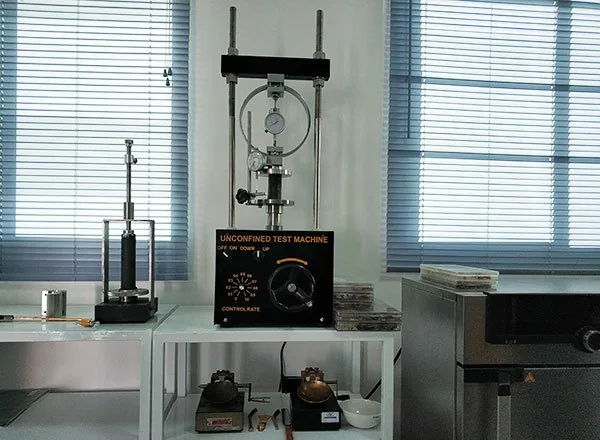
Unconfined Compression
Used for suitable cohesive soil specimens to determine unconfined compressive strength under the specified procedure.
Compaction & CBR
Available where required for earthwork, fill or pavement-related project scopes and where suitable material is provided.
Not every test is appropriate for every sample
Laboratory test selection should consider the soil type, whether the specimen is disturbed or relatively undisturbed, the amount of material available and the information required by the engineering team. For that reason, the quotation should identify the requested tests or the intended information whenever possible.
How laboratory results fit into a soil investigation
| Test | Typical purpose | Commonly associated information |
|---|---|---|
| Water Content | Moisture condition of the sample | Sample depth, soil description, consistency |
| Unit Weight | Mass/volume property of the specimen | Sample condition and depth |
| Atterberg Limits | Plasticity characteristics of fine-grained soil | Soil classification and moisture relationship |
| Sieve Analysis | Particle-size distribution | Classification of coarse and mixed soils |
| Unconfined Compression | Strength of suitable cohesive specimens | Consistency and sample quality |
| Compaction / CBR | Earthwork or pavement-related evaluation | Fill material and project specification |
Testing should follow the agreed project requirement
Where a project specification identifies a particular ASTM or other recognized test method, the requested method should be stated in the quotation or test instruction. This prevents ambiguity and helps ensure the reported result matches the intended engineering use.
Read the laboratory testing guideNeed a laboratory testing quotation?
Tell us the sample source, quantity, requested tests, project specification and required turnaround so the laboratory scope can be reviewed.