
A soil boring log condenses field observations and test information into a vertical record of one borehole. At first glance it can look like a dense page of abbreviations, numbers, symbols and soil descriptions. The most useful way to read it is depth by depth: confirm the borehole identity and reference elevation, then move downward through the soil profile while matching samples, Standard Penetration Test results, groundwater observations and laboratory data to the same interval.
This guide is intended for project owners, consultants, contractors, architects and design teams who need to understand what a boring log is showing before discussing the results with the responsible engineer. It explains how to read the record itself; it does not replace geotechnical interpretation or foundation design.
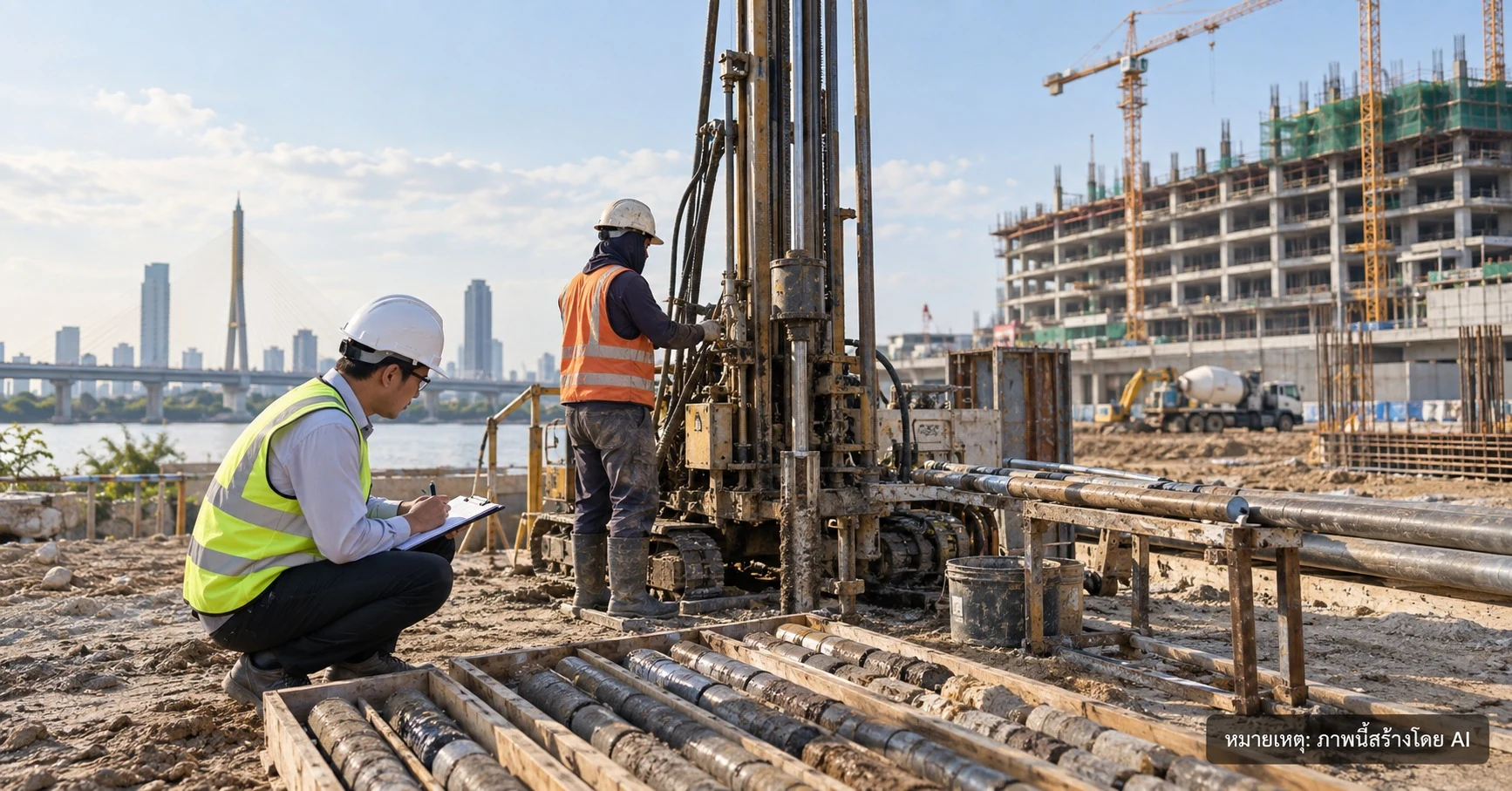
What is a soil boring log?
A soil boring log is a depth-based record of an investigation hole. It typically brings together the borehole number, ground elevation, drilling depth, soil descriptions, sample intervals, in-situ test results, groundwater observations and selected laboratory results. The exact layout varies between investigation providers and projects, so the headings, legend and abbreviations on the report should always be checked before interpreting symbols.
The log is one output of a broader soil investigation. Its main role is to organize what was encountered, sampled and tested at a particular location. Engineering recommendations such as foundation type, allowable capacity or pile design normally require interpretation of the complete investigation rather than a single number copied from one line of the log.
A practical reading order
If you have not worked with a boring log before, the following sequence helps keep every observation tied to the correct depth:
- Confirm the project, borehole number, location, ground elevation, dates and final depth.
- Follow the depth scale from the ground surface downward.
- Identify where soil descriptions and layer boundaries change.
- Match each sample and in-situ test to its recorded depth interval.
- Read SPT N-values together with the soil description and test interval.
- Check groundwater observations and the timing of those observations.
- Relate laboratory results back to the correct sample and depth.
- Confirm where the boring ends and whether the termination condition is stated.
1. Start with the header before reading the soil profile
The header establishes the context for everything below it. Before looking at a strength value or soil layer, verify that you are reading the correct borehole and the correct project.
Borehole number and location
Each borehole should have a unique identifier such as BH-1, BH-2 or another project-specific label. That identifier should correspond to the site plan or investigation layout. Two boreholes only a short distance apart can encounter different fill thicknesses, layer boundaries or depths to dense soil or rock, so the location is part of the meaning of the log.
Ground elevation and reference level
Depth is normally measured downward from the ground surface at the borehole. Ground elevation allows the reader to compare the actual elevation of soil boundaries between boreholes that start at different surface levels. On a sloping or graded site, the same depth below ground at two holes does not necessarily represent the same elevation.
Dates, drilling method and final depth
The start and finish dates establish when the field record was made. The drilling method and final depth provide context for sampling and termination. Where the log records refusal, rock coring or another termination condition, read that note together with the final depth rather than assuming every hole simply stopped at a planned depth.
2. Follow the depth scale from top to bottom
The depth column is the backbone of a boring log. Soil layer boundaries, sample intervals, SPT tests, groundwater observations and laboratory results should all be related back to this scale.
For example, if a soil description changes at 6.00 m, a test recorded at 4.50 m belongs to the material above that boundary while a test at 7.50 m belongs to the material below it. Misreading vertical alignment is one of the easiest ways to combine information from unrelated intervals.
Where a boring log continues onto another page, confirm the continuation depth. Page breaks are a document-layout issue and do not necessarily coincide with a change in soil layer.
3. Read the soil description as a description of material encountered
The soil-description column normally identifies the principal soil type and may include secondary constituents, colour, consistency or relative density, moisture condition and a classification symbol. Wording depends on the logging and classification system used for the project.
Major soil groups can include clay, silt, sand and gravel, with modifiers such as silty, sandy or with gravel where appropriate. Fine-grained soils may also be described by consistency, while coarse-grained soils may be described by relative density. Graphic patterns help the reader scan the profile, but hatch patterns are not universal. Use the legend supplied with the report rather than assuming the same symbol always means the same soil.
4. Match samples and tests to the same depth interval
A log may show disturbed samples, relatively undisturbed tube samples, split-spoon samples, rock core runs or other sampling methods. Abbreviations vary between report formats, so the project legend is the correct reference.
The key question is not only “what type of sample is this?” but also “from what depth was it recovered?” A water-content, unit-weight or strength result is useful only when it is traceable to the correct specimen and interval. Sample numbers should therefore connect the boring log with the corresponding laboratory result sheets.
5. Understand SPT N-values in context
The Standard Penetration Test (SPT) is commonly performed at specified depths during borehole investigation. The reported N-value is a field penetration-resistance index for the test interval. It should not be treated as a stand-alone soil classification or an automatic foundation-design value.
When reviewing an N-value, check four items together:
- the test depth;
- the soil description at that depth;
- the sample or test interval; and
- whether the report is showing the field value or a corrected/interpreted value elsewhere.
For more detail on what an N-value represents and why context matters, see Understanding SPT N-Values in a Soil Investigation Report.
6. Read groundwater observations carefully
A groundwater entry on a boring log is an observation made under the conditions and timing stated in the field record. Water level can be influenced by season, recent rainfall, site drainage, nearby water bodies, drilling water, elapsed time after drilling and local geology.
For that reason, a single groundwater depth should not automatically be treated as a permanent year-round level. If the report distinguishes water encountered during drilling from a later observed level, keep those observations separate. Where no meaningful level could be observed, the report may use a dash, blank, “not observed” or another project-specific notation.
7. Use laboratory results to support the field record
Laboratory testing can add measured properties to the soil description and sample record. Depending on the project scope and sample condition, a boring log or accompanying summary may contain results such as:
- Water content — moisture condition of the tested sample.
- Unit weight — weight per unit volume for a suitable specimen.
- Atterberg limits — liquid limit, plastic limit and related plasticity information for fine-grained soil.
- Sieve analysis — particle-size distribution of the material tested.
- Unconfined compression — compressive strength for a suitable cohesive specimen under the specified procedure.
Not every specimen is suitable for every laboratory test. Test selection should reflect the soil type, specimen condition and information required by the project. See the Laboratory Soil Testing service and Laboratory Soil Tests Commonly Used in Soil Investigation for related information.
8. Check the end-of-boring note
The bottom of the log should identify the final investigated depth. It may also indicate why the borehole ended—for example, planned target depth, refusal, rock, decomposed rock or another site-specific condition. A final depth by itself does not establish that a particular bearing layer was found. That conclusion requires interpretation of the complete profile and the project requirements.
Read the boring log as one connected record
The following example is illustrative only. It shows how to connect entries by depth rather than reading isolated values as independent conclusions.
| Depth / item | What the log might show | How to read it |
|---|---|---|
| 0.00–1.50 m | Fill or near-surface material | Identify whether the material is natural soil or placed material and note its thickness at this borehole. |
| 1.50–6.00 m | Fine-grained soil, samples and SPT results | Read consistency, sample data and N-values together; one test should not represent the entire layer automatically. |
| 6.00–12.00 m | Different soil description with changing penetration resistance | Confirm the layer boundary and follow the trend by depth instead of jumping directly to the largest N-value. |
| Groundwater | Observed level and timing | Treat it as an observation under stated field conditions, not a permanent fixed level. |
| Final depth | End-of-boring or termination note | Confirm why the hole ended before making assumptions about deeper material. |
Common mistakes when reading a boring log
Reading a number without checking its depth
An SPT value, water-content result or strength result from one interval should not be combined with a soil description from another interval.
Treating one borehole as the whole site
A borehole records conditions at one investigation location. Correlation between holes can show trends, but subsurface conditions may vary between points. Borehole quantity and arrangement should follow the project footprint, expected ground variability and the responsible engineering team’s requirements.
Assuming graphic symbols are universal
Always use the legend supplied with the report. Similar-looking patterns can represent different materials in different logging formats.
Assuming groundwater is constant
Groundwater can vary with time and site conditions. The observation date, timing and method are therefore part of the record.
Using one SPT value to select pile length or capacity
A boring log provides important investigation data, but foundation design also depends on the full soil profile, structural loads, foundation or pile type, design method, safety factors and engineering interpretation. A single field value should not be converted directly into a design decision without that review.
What a useful boring log should let you verify
A well-organized log should allow the investigation record to be traced from the borehole location down to the individual sample or test. As a reader, you should be able to answer:
- Which borehole am I reading and where is it located?
- What are the ground elevation and final investigated depth?
- Where do the principal soil layers begin and end?
- At what depths were samples and SPT tests taken?
- Which laboratory results belong to which samples?
- What groundwater observation was recorded and when?
- Why did the borehole terminate?
If these relationships cannot be traced clearly, ask the investigation provider or project consultant for clarification before relying on the record.
How the boring log fits into the complete soil investigation
A boring log is most useful when read together with the borehole location plan, laboratory result sheets, field-test records and any project-specific engineering interpretation. If you are planning a new investigation, the soil investigation quotation checklist explains the project information normally needed to define the requested scope before mobilization.
For project-specific fieldwork, see Soil Investigation Services in Thailand. If the site plan, required boreholes and target depth are already available, you can also request a soil investigation quotation.
Frequently asked questions
Is a boring log the same as a geotechnical report?
No. A boring log is normally one part of the soil investigation or geotechnical report. It records the profile and test information for a particular borehole. A complete report may also include a location plan, laboratory results, summaries, interpretations and project-specific recommendations.
What does SPT N-value mean on a boring log?
It is the penetration-resistance value reported for the Standard Penetration Test interval. It should be read with the soil description, test depth and other investigation information. Depending on the engineering method, corrections or correlations may be applied separately.
Can SPT N-values from different depths be compared directly?
You can review the trend, but each value should first be placed in its depth and soil context. A change in N-value may occur with a change in soil type, density or consistency and may also require consideration of other field and testing factors.
Why can the groundwater level differ from a later site observation?
The logged level is an observation made at a particular time and under particular field conditions. Seasonal variation, rainfall, drainage, nearby water bodies and the time allowed for the borehole to stabilize can affect later observations.
Can one boring log represent an entire project site?
Not automatically. One borehole is a point investigation. The coverage needed for a project depends on site size, structural layout, expected subsurface variability and the requirements defined by the responsible engineering team.
Can pile length be selected from the deepest high SPT N-value?
No single N-value should be used by itself to select pile length. Pile design requires the complete soil profile, pile type and dimensions, structural loads, the applicable design method and engineering review.