
Soil samples are not interchangeable. A sample collected mainly for identification and classification does not need to preserve the natural soil structure to the same degree as a specimen intended for strength, density or compressibility testing. That is why a soil investigation may include both disturbed samples and relatively undisturbed samples from the same borehole.
The practical question is not simply “which sample is better?” It is which sample quality is appropriate for the test and engineering information required. The sampling method, soil type, borehole condition, handling and laboratory program all affect that decision.
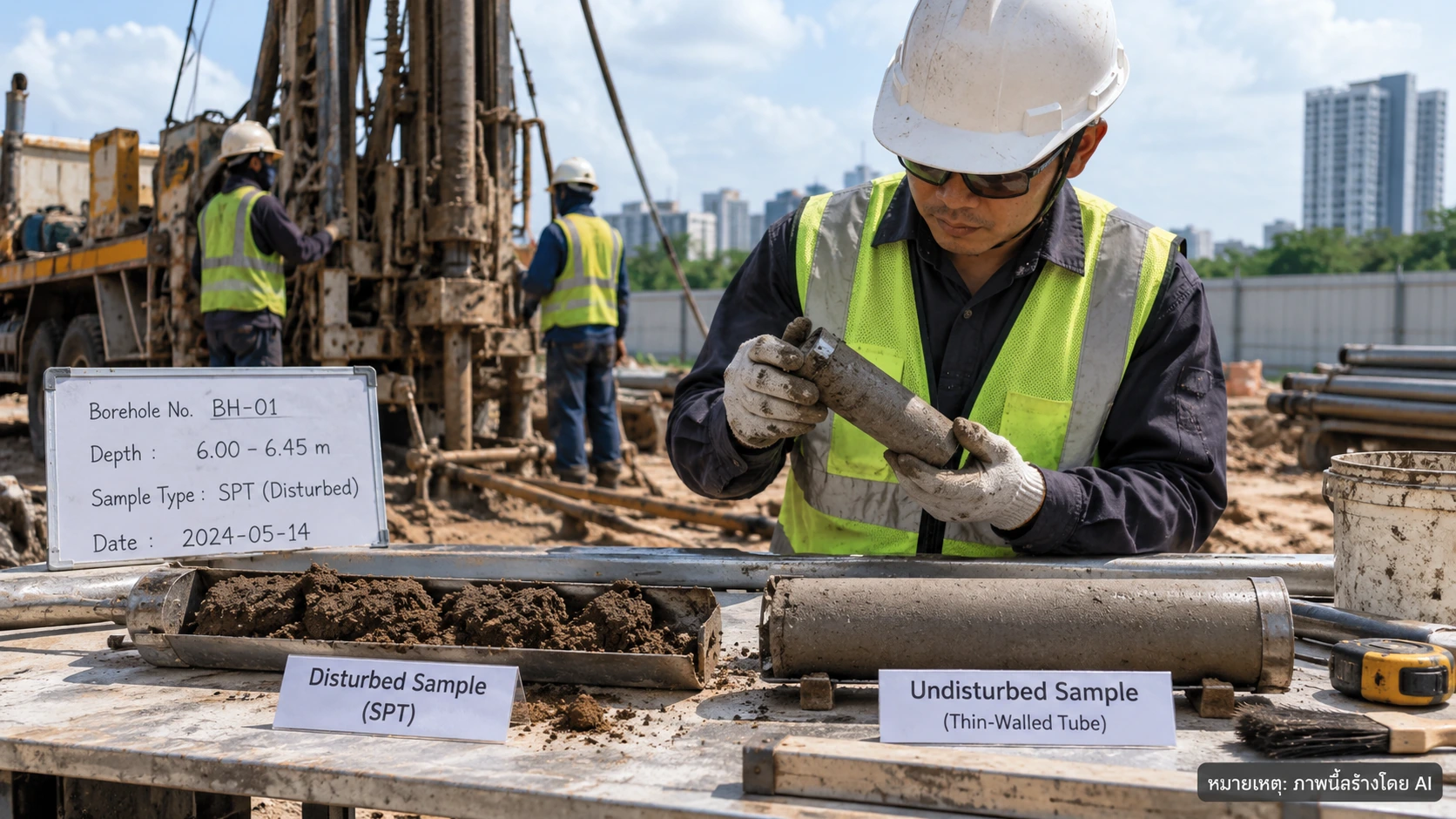
The difference in one table
| Sample type | What is preserved | Typical purpose |
|---|---|---|
| Disturbed sample | Soil particles and composition may remain representative, but the natural structure, stress condition and particle arrangement have been altered. | Visual identification, classification and tests that do not depend strongly on intact soil structure. |
| Relatively undisturbed sample | The natural fabric, density and moisture condition are preserved as closely as practical during recovery and handling. | Tests where strength, compressibility, density or other structure-sensitive properties are required. |
What is a disturbed soil sample?
A disturbed sample has undergone enough movement, remolding or deformation during collection that its original in-situ structure is no longer preserved. The soil may still be useful and representative for many purposes because the constituent particles and general composition can remain identifiable.
Common examples in a borehole investigation include material recovered from a split-spoon sampler during the Standard Penetration Test and representative bulk or grab material collected for classification testing. The act of driving a split-spoon into the soil produces substantial strain, so the recovered material should not be treated as an intact specimen simply because it has a cylindrical shape when the sampler is opened.
What can a disturbed sample tell you?
Depending on the sample condition, quantity and project specification, representative disturbed material can support information such as:
- visual soil description and identification;
- grain-size distribution or sieve analysis;
- Atterberg limits for suitable fine-grained material;
- soil classification;
- selected moisture-content testing when sampling and preservation are appropriate; and
- other tests intended for remolded or representative material.
The exact test schedule should still be confirmed against the project requirements and the available material. A disturbed sample can be entirely appropriate for one test and unsuitable for another.
What is a relatively undisturbed soil sample?
A relatively undisturbed sample is collected using a method intended to preserve the natural soil fabric, density and water condition as closely as practical. Thin-walled tube sampling is one common approach in suitable cohesive soils. Other sampling systems may be required for different ground conditions or higher sample-quality requirements.
The word relatively matters. Sampling changes the soil stress state, and additional disturbance can occur while the sampler enters the soil, during recovery, sealing, transportation, extrusion and specimen preparation. A tube that looks full does not automatically contain a high-quality specimen.
Why relatively intact structure matters
Some laboratory properties depend strongly on the arrangement of particles and voids that existed in the ground. If that structure is substantially remolded before testing, the laboratory result may no longer represent the in-situ material in the way the engineering team intended.
Relatively intact specimens are therefore commonly considered where the laboratory program requires information related to strength, compressibility, density or other structure-sensitive behavior. Whether a particular sample is suitable for a particular test should be confirmed by the laboratory and responsible engineering team after considering sample condition and the specified method.
SPT samples and tube samples serve different purposes
The Standard Penetration Test (SPT) combines a field penetration-resistance measurement with split-spoon sampling. The reported N-value comes from the resistance recorded while driving the sampler; the recovered material helps identify the soil encountered at that depth. The sample itself is disturbed by the driving process.
A thin-walled tube sample is collected for a different reason. Where the soil and project scope allow, the objective is to recover material with much less structural disturbance so that selected laboratory tests can be performed on a specimen closer to its field condition.
These are complementary rather than competing methods. A soil investigation may use SPT at specified intervals for field resistance and identification while also collecting tube samples from selected cohesive layers for laboratory testing.
Match the sample to the laboratory test
The test program should be considered before field sampling begins. If the laboratory requires a specimen with preserved structure but the field program collects only disturbed material, that information cannot be recreated later by repacking the soil into a tube.
| Information or test | Typical sample consideration | Why |
|---|---|---|
| Visual identification / classification | Representative disturbed sample may be suitable. | Identification focuses mainly on material composition and observable characteristics. |
| Sieve analysis / grain-size distribution | Representative disturbed material is commonly suitable. | The test evaluates particle-size distribution rather than intact fabric. |
| Atterberg limits | Representative fine-grained disturbed material is commonly suitable. | The test evaluates consistency limits of prepared soil rather than preserving the in-situ structure. |
| Water content | Representative sample with suitable sealing and handling may be used where specified. | Moisture can change after recovery, so preservation and timing matter. |
| Unit weight / natural density | Relatively intact specimen is generally preferred where natural condition is required. | Volume and fabric should represent the field specimen as closely as practical. |
| Unconfined compression or other strength testing | Relatively intact cohesive specimen may be required, subject to the selected method. | Strength can be sensitive to disturbance, fissuring and specimen quality. |
| Consolidation / compressibility testing | Higher-quality relatively intact sampling is normally important. | Compressibility depends strongly on soil structure and stress history. |
This table is a planning guide, not a substitute for a project test specification. Test selection depends on soil type, sample quality, specimen size and the information required by the responsible engineering team. For a broader overview, see laboratory soil tests commonly used in soil investigation. For project-specific test availability and quotation scope, see Laboratory Soil Testing Services in Thailand.
What causes sample disturbance?
Sample quality is influenced by more than the name of the sampler. Important field and handling factors include:
Soil type and consistency
Soft cohesive soil may be recoverable in a thin-walled tube, while very hard, cemented, gravelly or highly granular materials can require different techniques. A method that works well in one layer may perform poorly in the next.
Borehole preparation
Loose cuttings, softened material or disturbed soil at the bottom of a borehole can contaminate the next sample. The sampling level should correspond to the intended depth and the hole should be prepared appropriately for the selected procedure.
Sampler insertion and recovery
Driving, pushing, rotation, over-penetration and excessive friction can alter the specimen. The correct procedure depends on the sampler and soil condition.
Sealing, transport and storage
Moisture loss, vibration, impact, temperature exposure and poor orientation control can continue to disturb a sample after it leaves the borehole. Field recovery is therefore only one part of maintaining usable sample quality.
Laboratory specimen preparation
Extrusion, trimming and selection of the test specimen can reveal or introduce additional disturbance. Visible cracks, inclusions, poor recovery or deformation should be considered before a result is treated as representative.
How sample information should appear in the boring record
Every sample should remain traceable to the location and depth from which it was collected. A useful field and reporting chain normally includes:
- borehole number;
- sample number or identifier;
- sample type;
- from/to depth or sampling interval;
- recovery or specimen condition where recorded;
- field description;
- requested laboratory tests; and
- reported laboratory results linked back to that sample.
This depth-based traceability is one reason sampling cannot be separated from the rest of the soil investigation workflow. The sample should connect the field record to the laboratory result and, ultimately, to the soil boring log.
How to define sampling in a project scope
For quotation or investigation planning, it is useful to identify the engineering information needed before simply listing sample types. A practical sequence is:
- Define the required information. For example, classification only, strength-related testing, compressibility testing or a project-specific laboratory schedule.
- Identify the expected specimen requirements. Consider sample type, diameter or quantity where the specified test method requires it.
- Set the sampling and testing intervals. The responsible engineering team should determine where samples or tests are required by depth and soil condition.
- State the applicable test or project specification. Where specified, work procedures can reference applicable ASTM or other recognized methods required by the project.
- Plan preservation and transport. Samples should reach the laboratory in a condition appropriate for the requested test.
If these details are not yet fixed, provide the available project drawings, target borehole depth and intended test requirements with the soil investigation quotation information so the scope can be reviewed before mobilization.
Common mistakes when planning soil sampling
Assuming “undisturbed” means perfect
All sampling changes the soil to some degree. Sample quality should be judged against the intended test rather than the label alone.
Requesting a structure-sensitive test after collecting only disturbed material
Once natural fabric has been substantially lost, repacking the sample does not reproduce the original in-situ structure. Sampling and laboratory planning need to be coordinated in advance.
Treating every recovered tube as suitable
Recovery length alone does not prove specimen quality. Deformation, cracking, inclusions, disturbance at the ends of the tube and handling history can all matter.
Using the SPT sample as if it were an intact strength specimen
The split-spoon sample is valuable for identification and appropriate laboratory tests, while the SPT N-value provides the field penetration-resistance record. The driven sample should not be assumed to preserve natural structure for tests that require an intact specimen.
Separating laboratory results from sample depth
A test result only has useful context when the borehole, sample number and depth interval are known. That relationship should remain clear from field labeling through final reporting.
Frequently asked questions
Is an SPT split-spoon sample disturbed?
Yes. Driving the split-spoon during SPT causes substantial deformation of the recovered soil. The material is useful for identification and laboratory tests appropriate for disturbed material, while the SPT N-value is the separate field penetration-resistance measurement.
Does a thin-walled tube guarantee an undisturbed sample?
No. A thin-walled tube is intended to reduce disturbance in suitable soils, but sample quality also depends on soil type, borehole preparation, insertion, recovery, sealing, transport and laboratory preparation.
Which soil tests need an undisturbed sample?
Tests intended to represent natural strength, compressibility, density or other structure-sensitive behavior commonly require a relatively intact specimen. The exact requirement depends on the selected test method and project specification.
Can disturbed samples be used for Atterberg limits and sieve analysis?
Representative disturbed material is commonly suitable for classification-related tests such as Atterberg limits and grain-size analysis because these tests do not rely on preserving the original soil fabric in the same way as strength or consolidation testing.
Can an undisturbed sample be collected from sand?
Obtaining a high-quality intact sample from granular soil can be difficult and may require specialized techniques. The practical method depends on density, grain size, groundwater conditions, equipment and the engineering information required.
How should soil samples be identified in the report?
Each sample should be traceable to its borehole, sample number, depth interval and sample type. Laboratory results should use the same identifiers so the reader can connect each result to the correct location in the boring log.